
The Chicago band Fer de Lance play a style of music that broadly falls under the banner of epic metal but goes well beyond it. An in-depth conversation with band members Patrick “Rüsty” Gloeckle and Matt “MP” Papai about ancient myths in metal, rebetiko, and the deep-seated need to scream lyrics into a microphone.
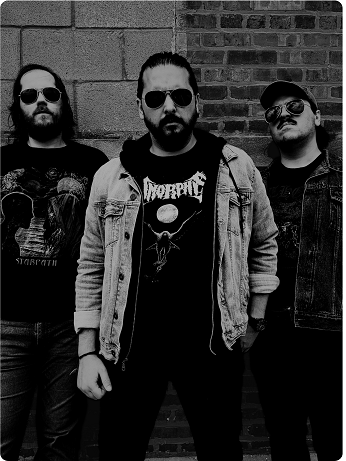
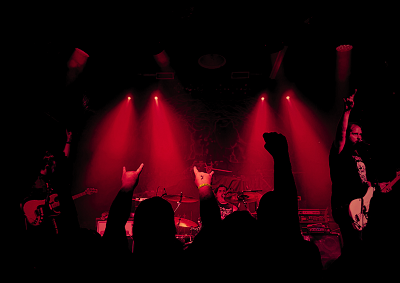
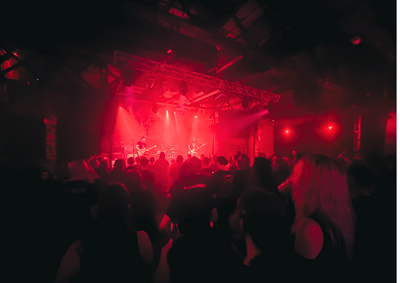
Taking their new album across Europe: Chicago epic metal band Fer de Lance. (all photos: MP/Fer de Lance)
woxx: In a few days, you’ll be heading to Europe to tour with your latest album. Judging from your previous experiences in Europe, what are your expectations?
Rüsty: Man, I mean, judging from the previous experience, it was like a heavy metal dream come true. We had amazing shows, we played Keep It True Festival, we toured with Visigoth and Sanhedrin, great bands and great people. I think all the shows that we played were sold out. So the expectation for this time is, hey, let’s have another heavy metal dream and bring the music to the people. And we have a lot of new songs to play. A whole new album has come out since we were last in Germany, in Europe, so we’re excited, I think most of all, to share some new music.
For me, you are probably one of the best examples at the moment of how the heavy metal underground can carry a band without a big promotional machine behind it, driven only by dedicated fans and your music. Would you agree with that assessment?
Rüsty: Yeah, I think so. I don’t think we have any grand master plan for taking over the heavy metal world. We write songs and they’re real songs and people are hearing that. And if it takes five years, it’s kind of where we’re at. We’ve been doing this for about five years since the first record, “Colossus”. And it seems like it’s growing nice and slow and steady. And it feels good. And we have done pretty much everything ourselves. We booked this entire tour DIY. We booked all the shows ourselves. We don’t have a booking agent for this one or anything. And it’s a lot of work. But there’s a pride in that and we make sure that we have full control over everything.
MP: But of course, Enrico from our label “Cruz del Sur” is doing a good amount of work with us, and putting out the albums is usually a really easy process because he’s really easy to work with. This applies to the whole team at Clawhammer PR and the like as well. It seems like, when we get that album out, it’s all hands on deck and we’re going for gold.
Rüsty: Yeah, each release has been bigger, and that’s kind of cool because we’re still just doing our thing.
Apart from the albums themselves, I was completely blown away by the power and joy you brought to the stage three years ago when I saw your show in Stuttgart. What does it mean to you to be on stage? Is this the moment you’re ultimately working towards? Because initially you started out as a studio band, right?
Rüsty: Indeed, we started out really just as a studio band. MP and I had a band before Fer de Lance, that was called Moros Nyx. That was more power metal, more rooted in some of our influences along the lines of Gamma Ray, Helloween, and Blind Guardian, to name a few. So we’ve always been into high-energy music. And then MP started writing some darker songs, and it just made sense to switch over and do that band. Those songs were speaking to me, and we kind of haven’t looked back since.
MP: We started as a studio band just because we were all at different places. There’s a long history of Rüsty and me enjoying live performances. Every once in a while in America, we hit an audience and their arms are crossed, they’re standing in the front, and you have to really win them over. That’s a lot of work, especially as someone who’s playing guitar and singing at the same time like I do. It’s exhausting sometimes. And what I really like about German fans is that they have decided right away whether they like you or they don’t like you. So you don’t have to win anyone over, and it’s just a lot of joy the entire time. So I cannot wait to get back to the German people.
Rüsty: I feel we’ve really come into our own in the last few years as a live act. We’ve had some different lineups, but the core has kind of stayed together with Scud and MP and me. And now being a three-piece, Scud and I are singing more. There’s so much going on when we are on stage now that you have to be all in. And as MP said, when you have everybody there who wants to see you, that makes our work really, really easy. And that’s when we can have a lot of fun. And that’s one of those heavy metal dreams.
Playing as a three-piece
You just mentioned that you are down to a trio at the moment. What specific challenges does this pose for you in your live shows, keeping in mind that there’s so much going on in your music on the albums?
MP: At its very essence – and you can hear this on Colossus –, these are really just simple folk metal songs. As long as we make sure to just take the simple song and make it powerful, as long as we’re strong in that, I can add all the extra stuff that maybe the guitar needs. The background vocals that Scud and Rust have provided are game-changing. And our live versions of the songs are entirely new songs, for those who are really paying attention. You’ll hear the chord changes that you want to hear, but you’re also going to hear the bass doing a lot of extra work. You’re going to hear the drums doing some extra work. So it has been a big challenge to go to a three-piece but I think it has also been a lot more rewarding to figure it out with the people who are putting in the 200 per cent that is required.
Rüsty: I think, in short, we’ve just had to get a lot better and practice a lot more. And as I am entering my 40s – or actually, I am in my 40s, to be honest – it feels good to keep improving and not just keep playing the same thing over and over.
Pathos in spades, Greek mythology, and songs of epic length: Chicago-based three-piece Fer de Lance – Matt “MP” Papai (vocals/guitar), Patrick “Rüsty” Gloeckle (bass), and Travis “Scud” Scudder (drums) – are considered at the forefront of the New Wave of Epic Metal. Their blend of styles appeals to fans of classic heavy metal as much as to followers of doom and black metal. From September 3 to 12, the band will be touring mainly in Germany to present their third album, „Fires on the Mountainside“ (Cruz del Sur).
So it’s a challenge, but in a good way.
Rüsty: Yeah, I think so. Some of the albums were more a product of the studio, with some songs coming in at the very last minute. In this case, the bass was maybe not the most important element of a song all the time. So it wasn’t really like the bass parts needed to be fancy, because we had all these tracks layered on. But when we play live, you know, even before we became a three-piece, all the bass parts were totally different from what’s been recorded, especially the older songs. And, as MP pointed out, there’s so much melody going on. So yeah, some of us have had to change what we’re doing, and that’s been a lot of work, but fun and rewarding and almost like songwriting. We don’t really do a lot of songwriting collaboratively, we do a lot of arranging, but moving to the three-piece, I feel like we have to do a little more together. I feel like we have got to understand each other a little more. And Scud and I have had to get a lot better at singing, too. Actually it feels very powerful.
So was it a deliberate decision to play as a three-piece now, or was it simply because your second guitar player decided to quit?
Rüsty: At the end of our East Coast U.S. tour, our second guitar player, Jason Geist, ended up leaving the band. It was all very friendly. He just had some family stuff to take care of, and he also has another band that he plays in. It was definitely a shock, but it all happened respectfully, and we’re still friends. We did some experimenting with a keyboard player and played one show that way. It just didn’t quite work out given how much time we still had until we had to get ready for the tour. So we had to put that aside for now and just go for it as a three-piece. The first show as a three-piece was in June. We played with Worm, and holy moly, they were good.
Will you have a lot of stuff on playback, like pre-recorded keyboards being played during the show, or will you go without all of that?
Rüsty: No, we’re not using any playback at all.
Sounds good to me.
MP: I can say we’re maybe fundamentally against playback during a live show.
Rüsty: I’m 100 per cent against playback during a show. No backing tracks, please.
MP: We don’t have the technical ability to do it either, so it’s both we’re against it and we couldn’t do it if we tried.
Rüsty: Shhh! But we could, for sure. We could figure it out. But we won’t. It feels better to know that everything that the audience is hearing is coming from us live.
How can you even afford to go on tour today, financially, especially as a band from the US touring Europe? What does it take to pull that off?
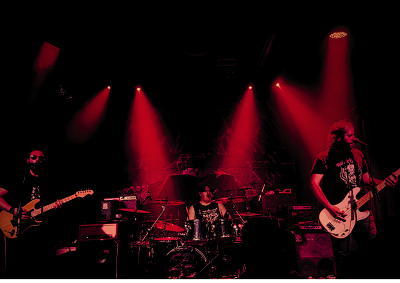 Rüsty: We were very lucky. Our latest album, “Fires on the Mountainside”, did very well. So we were able to fund this whole upcoming tour with money that we made from previous shows and from the album releases, which is really important to me. We’re not spending our own personal money to experience a heavy metal fantasy camp. That might sound a little petty, but I’ve been there in the past. It was awesome back then. But it feels really good when you’ve earned the money from the music that you’ve made and the shows that you’ve played, and then you can use that money to organize new stuff. Touring is not cheap, it’s very expensive. We’re basically broke right now, but we should do pretty well on this tour. That’s not to say we’re not having issues. The reality is that you’re breaking even at best, I think. But it felt very good to be able to fund this ourselves.
And I also should mention that we have great support from our label Cruz del Sur, namely Enrico. They do really a good job of taking care of us when we are in Europe, making sure we have merch and shirts and all that. I don’t think the tour would be possible without Cruz del Sur. So a big shout-out to Enrico. He’s a big part of why we were able to go to Germany last time and why we’re coming back to Europe now.
“If they book us, we will come”
How important is the fact that you are invited to a festival again? Last time it was Keep It True that kicked off the tour a bit, and this time you are on the bill at the Storm Crusher Festival. Would you have been able to pull this off without these festival bookings?
MP: We have a great saying that every time we get a question like, “Are you going to come to our country? Are you going to come to this place?”, we always answer, “If they book us, we will come.” And so three years ago, Storm Crusher asked us to play their fest, and we were unfortunately unable to do it. And we just heard from so many people, “You’ve got to go to Storm Crusher – it’s a great fest.” And so when the next invitation came in 2025, we immediately said, okay, we’re doing it. And then we thought, okay, now we have to book a tour around it.
Putting on shows and organizing festivals is getting more and more expensive, especially since the pandemic, to the point of asphyxiating smaller festivals, show promoters, and bands. Do you think this situation still offers the possibility of a thriving underground below this semi-professional level, given that the underground heavily relies on the DIY spirit of the whole thing?
Rüsty: I think I would go back to: You gotta just keep doing your thing. People will take note. Cruz del Sur took note of us. Keep It True took note of us, Storm Crusher took note, and so on. So just keep doing your thing. I definitely think it’s possible to have cheaper shows. Everything is super expensive now, but I don’t think it has to be. If you look at “Brofest” in the UK for example, I bought a ticket for that festival and I hope that I’ll be able to go. It’s a “New Wave of British Heavy Metal”-themed festival in Newcastle, and the tickets are 65 pounds for three days and a whole bunch of bands. It doesn’t necessarily have to be that expensive. We just need people who are willing to put their foot down.
MP: About Rüsty’s point of doing your own thing: We already have 14 demos written for future Fer de Lance material, and I have maybe seven songs that are just finished, songs that I wrote because it feels great to write a song. And I think as economies tank or as the gap between those who have and those who don’t have gets wider, you can’t take that ability to write songs away. So even if we can’t afford to go to Germany in the future, if we can’t afford to do anything in the future, it’s great to be able to write a song. And to just keep doing what we want to do.
Rüsty: And we’re very lucky to be based in Chicago. It’s such a big city and you would probably need both your hands to count all the great hard rock and heavy metal venues, ranging from big venues to really small joints, that we have in this town. So we’re pretty lucky here. There’s no shortage of quality shows at venues here in town of all kinds of different sizes. I think some of the more successful shows are the ones that cross genres. In this sense, Fer de Lance is a good fit for shows because we get down with some of the black metal kind of atmospheric stuff, with power metal, and just straight-up heavy metal. I think those shows where there’s a little bit of everything for fans are the ones that seem to be successful.
Fires on the Mountainside
I have quite a few questions coming up regarding the latest album. I know that it’s a concept album, and you have already talked about it in other interviews, but maybe you could still tell us a bit about the story you are telling there.
MP: Yeah, it is a concept album. So far we have only written concept albums, for all three releases, if we include the “Colossus” EP. “The Hyperborean” was very much a linear story, and I wanted to make Fires on the Mountainside a very non-linear story. I was really inspired by my background I have in classics, as in archaeology and Roman and Greek history, but I was also strongly inspired by Nikos Kazantzakis’ book about the fall of Knossos (“At the Palaces of Knossos”; ed.).
In that book, Icarus was just a random character that appeared on maybe two or three pages. Kazantzakis retells the story, the myth, in the way he wants. I thought, “You know what, that’s a really good idea!” I’ve never liked the lesson of the Icarus myth that is mostly told: “Don’t fly too low, don’t fly too high, do as your father says and you’ll be all right.” I never liked that. So I wanted to change that lesson and I made him kind of a sacrificial hero, but a sacrifice for definitely the greater good.
The story of the Fires on the Mountainside song explores Icarus as both a legendary hero and a sacrificial hero. The other songs on the record provide context of what I see as archaic Knossos, a place where rich and poor live. I guess in Germany today, they live maybe one kilometre apart, so pretty close, but their lives are completely different. In Knossos, the rich are living in the palace centre and the poor are living in the fields. And I don’t see that much difference between that reality and our own reality today. And as I always do with Fer de Lance songs, I wanted to have one foot in the archaic, in the ancient, and one foot in our current reality. Throughout time we’ve always had this imbalance of hierarchies and differences between people. And Icarus was a great myth to show that you can actually fly as high as you want, but keep your eye on what’s going on and make sure that you’re helping out.
Why did you choose this particular lyrical style?
MP: I grew up with power metal. I love a song about the “Lord of the Rings” or dragons or…
Rüsty: …breaking chains, breaking the chains!
MP: Breaking various chains.
Rüsty: Yes. (Both laughing.)
MP: Or if you look at Virgin Steele, one of my favourite bands: they just sing about antiquity. For me, it wouldn’t feel like I’m doing anything important if I just sang about stuff like that. I need to sing about things that we encounter every day, but I look at them through a lens of antiquity, through a time that lies 2.000 years or more in the past, but doesn’t really seem to change.
Talking about breaking chains, I’ve got a particular question about the lyrics of Fires on the Mountainside. One verse says “Those with weighty thoughts, candles light their words, methods in madness, and truth cuts our cords.” I wanted to know whether, when you sing “truth cuts our cords”, this is related to breaking chains and no longer being bound, or whether it is rather related to the vocal cords being cut. In that sense, it could mean that nowadays truth has a silencing effect, that it has, in a certain sense, lost its power or has even become self-harming.
 MP: So far no one has ever brought this up. It’s both, in fact. We live in a world, especially here in the United States, where the truth is becoming an incredibly rare commodity. Maybe a commodity that we can no longer afford, and that only a certain class can afford. At the same time, if you’re speaking the truth, it can easily be cut off by a lie, thus cutting your cord, your vocal cord. It was important to me to focus on that section of the lyrics. It runs parallel to a section of the lyrics about the people who work with their hands and use fire for that reason. Fire also lights the way to write down the truth, to speak truth, to write down truth. And so I really wanted to focus on the fact that if there’s any sort of movement forward, any sort of progress to be made, we need both strong hands and truthful words. And fire is used for both those things.
Subverting Mythology
In the case of Fer de Lance, the label “epic metal” clearly goes beyond the musical style, as the reference to epic poetry is obvious. In their book “Dialectics of Enlightenment”, German philosophers Theodor W. Adorno and Max Horkheimer argue that the epic is already a critique of mythology, as it submits mythology to some form of rational logic. Do you see the same method at work in your lyrics?
MP: I am a big fan of Horkheimer and Adorno. So yes, I think that our style is obviously a way to subvert the mainstream and the culture industry. I really love to turn mythology, understood as a kind of power construct, on its head. The way I tell his story, Icarus doesn’t follow his mythology. He follows where I think that story should have gone. The same could be said about our previous album, The Hyperborean, where I subvert the whole idea of Hyperborea (a paradisiacal country in the north, according to Greek mythology; ed.). I guess only Colossus is me 100 per cent not subverting anything. It’s just me writing a bunch of songs.
I would tend to disagree.
MP: Why would you disagree?
To me, Colossus is a very personal song, especially if you have the Colossus of Rhodes in mind. The song is about the wish not to be affected too much by individual pain, but also by the suffering that’s going on in the world. At the same time, you know that it will never work. The very way these verses are written expresses a lot of pain by wishing the pain away. Your Colossus is a very fragile existence.
MP: You probably have paid closer attention to Colossus than maybe anyone else. What you have is the actual meaning of the song, but nobody has ever put two and two together, and brought that out. But I don’t think that’s me subverting anything. Well, maybe it is, I guess. The Colossus of Rhodes is the idea of strength and guiding ships into the harbor, versus a person just trying to get through daily life. I guess it is a subversive type of thing after all.
It’s my favorite Fer de Lance song to this day.
Rüsty: My favorite, too.
MP: Thinking about it even more, “Triumph and Tragedy” on the Colossus EP also follows this idea that a person feels so pointless just being alive, and that’s a tragedy. A person who feels so triumphant in the last fight of their life. That itself is a tragedy as well, because we’re only here one time and we’re here for a couple of years, and it’s a shame that we’re not enjoying it, that we’re not triumphant in our daily lives. So I guess I’m just breaking the rules through all the records. If we’re not subverting something, it doesn’t feel like a good day of work.
Rüsty: And a fun little piece of lore is that when MP sent me the demo version of Colossus, that was the song that convinced me: Okay, we gotta start a new band. That was the one.
MP: And Rusty, do you remember what we called the song in the studio?
Rüsty: No?!
MP: We called it Phil Collins, but Viking style.
Rüsty: Oh yeah! It’s definitely got a Phil Collins vibe. Well, I was mesmerized by that song. I never thought a song with basically the same drum beat over and over again could work. That was a very big learning moment for me, too. I was so impressed that you could write a heavy metal song where the drums didn’t change.
Three years ago in Stuttgart, when I asked you to play Colossus and you actually started playing it, only then did I fully realize: “Wow, this is really sort of a minimalist song.” Because you listen differently when you listen to an album at home. And playing the song in front of a crowd that’s already so fired up, that was quite the challenge. I almost felt a bit guilty in the beginning, because I thought, “I hope it will work out for them.” And it did, of course, as we all know. But the first one or two minutes, I was really like, ”Oh shit, I hope I didn’t do something stupid there.”
MP: In all honesty, we were worried, too. But I think that was the first time that anyone ever came up to us and said, “Can you play this song?” Not like shouting it out from the crowd, because that’s something else, but actually coming up to one of us and saying, “This is a song that means a lot to me, could you please play it at this show?” And I think I’ve only ever seen that once from another band. So when that happened and Rusty said, “Do you remember the lyrics for Colossus?” And I went, “Well, I’ll figure them out.” And we played it, and it was special. It was hard, but it was special.
Rüsty: And it was nice to have a little band meeting and everybody was totally stoked to do it, you know.
I really enjoyed it a lot and it meant a lot to me, so thank you again.
Rüsty: My pleasure. And we’re working on a slightly modified power-trio version of Colossus.
This is the Time of Monsters
I wanted to ask one last question about the lyrics. I really was intrigued by the answer MP gave in an interview with German magazine “Deaf Forever”. Manuel Trummer asked you about the meaning of the Gramsci quote included in the lyrics of “The Feast of Echoes”: “The old world is dying, and the new world struggles to be born: now is the time of monsters.” Gramsci wrote this under the impact of World War One, when a whole world order came to an end, and the corresponding power structures collapsed, something the Marxist thinker called an interregnum. And you said that if Gramsci were alive today, he would probably argue that this interregnum is still going on. Could you elaborate a bit on what you mean by that?
MP: I should get my PhD in philosophy after this interview (laughs). I guess, to answer your question, it starts by looking at Gramsci’s idea that culture rules over all, even over the economy. His idea was that culture is the grand controller of what nowadays would be called the narrative. And in this middle period, what he called the interregnum, between powers passing and powers arriving, we are constantly encountering monsters. Sometimes I ask myself if this was ever different. Maybe it’s Gramsci’s fault for not looking at things in a broader historical sense. But this interregnum between great powers is something I find interesting and that makes me dread waking up.
Apart from that, if you go online, if you look at the news, or you unfortunately have to go on social media and, all you see is a kind of grab for cultural resonance and what we, at least in the United States, call culture wars. I don’t know if Gramsci would have looked at that as a way of just discussing culture or as the actual battle between various historical blocs. These cultural wars are shifting our focus away from what’s actually happening. We here in the United States focus so much on gender and sex, and we ignore the terrible things that are happening to us and the terrible things that we do around the world.
In this sense, the interregnum is not powerful enough as a theoretical concept. But Gramsci was totally right in his analysis that culture is the impetus for both change and control, like we observe today in the discussion of which culture is the best. All of this is really kind of taking our minds away from what’s most important. That’s why I really felt that it was important to shout in the middle of Feast of Echoes that the world is full of monsters. And I think it’s really difficult not to think that you’re surrounded by monsters right now.
Music or Lyrics: Which Comes First?
 Let’s go back to the songwriting a bit and also to the combination of music and lyrics. In an interview you mentioned that you consider Feast of Echoes to be the first song chronologically. However you chose to open the album with the title track. Is the musical logic of the album different from that of the storytelling itself?
MP: Well, one of Rüsty’s great gifts is that he can listen to seven songs or whatever the album length is, and say, “You know what would be a really great song order that would flip everything on its head is if we put these songs on one side and these songs on another side!” And normally, as someone who was thinking of a linear story, I would say, “No, we can’t do that because this song leads into this song, so it won’t make any sense.” But with the song order that Rüsty proposed for Fires on the Mountainside, the more I thought about it, the more I thought: “That’s absolutely brilliant!” I don’t think that it would be a very strong album, if Feast of Echoes began the album. It’s an important song for sure, and it also contributes lyrically the most to this idea of me basically saying: This is what the problem is. The song is our “this is the problem” song, and I highlight religion, greed and hierarchies of power as the originators of what’s wrong with what’s going on in the story and maybe in real life. And so it would definitely be the first song following this logic, maybe followed by “Death Thrives (Where Walls Divide)”, as they kind of sum up what these powers want to achieve by dividing us.
And then the rest of the album has more of a narrative movement. “Raven’s Fly” is a narrative movement song. “Tempest Stele” refers to what stelae were in ancient times, like an announcement, in this case: “Look, Icarus flies!” “Fire and Gold” is a special song because first, it wasn’t written by me, and second, it takes place at a very distinct moment in the story. And I’m gonna pass this on then to the guy who wrote the song, Rüsty, for an explanation of that moment.
Rüsty: So Fire and Gold is the first Fer de Lance song that I wrote, and I would say that the inspiration for it sort of came from Colossus. I wanted to write another weird song. I handled the lyrics and then MP and I worked together on those as well. But the goal with Fire and Gold was to write a song of the people, the common folk that aren’t always mentioned in the songs or the history books. So that’s us trying to give a voice to the voiceless. They’re saying, “Truth is lie. In this light, everything dies. What hope do we have? There’s no heroes that are gonna come to save us. There’s no hearts of oak. We’re just gonna keep riding the wild wind.” I think that sums it up.
In what sense are the musical form and the literary form in your songwriting intertwined? Are you already thinking about the story in lyrical terms when you write a particular song, or do you adjust it to the structure of the song once it is written?
MP: The story comes into my head before any music is written. Or at least an idea of the story. And then the songs are going to be written. But the lyrics actually aren’t finished at that point. We’re still changing lyrics by the time we hit the studio. “Death Thrives” was adjusted in the studio, because you’ve been singing for a couple of days and you’re unable to kind of hit the breaths that you want to hit, so we started to change the lyrics and we ended up with some pretty cool lyrics and some pretty good new ideas. But basically it’s all centered around the theme of the story.
Do you see a sort of formal necessity, especially when it comes to the really long songs like Fire on the Mountainside, which is 13 minutes long? So in the process of composing, is there the point where you say, “Now this has to come, or this has to follow?” How organic – if this is the right word – is the formal structure of the song?
MP: The songwriting process is, and that’s the reason that I write so much, the songwriting process is just a brief moment in time of exploratory improvisation. It’s just me kind of really in the moment, thinking to myself: “What do I like, what do I want to hear, what do I want to say?” And then maybe six hours later, this thing emerges and it’s a song that I hope… I always hope it doesn’t change too much. But usually when it does change, it changes in a good way. And that’s because I pass it on to Rüsty or Scud. I don’t know if you would define that as organic. It’s definitely just such a quick and powerful and passionate moment that just… These things just come out. And I don’t question it, I don’t think too hard about it. Later in the studio, if somebody asks me, “How do you play this song?” I will go, “Well, that’s a great question…”
Rüsty: True story. True story.
MP: So if that’s what organic is, then it sounds better than oatmeal.
Rüsty: I got a name for it: lightning in a bottle.
On Rebetiko, or: Nothing Wrong with an Ouzo
Among your musical influences there’s also Rebetiko, a Greek musical style that is closely linked to forced displacement and expulsion, as it was brought to Greece especially by Greeks who were expelled from Turkey during the population exchange in 1923. What made you draw on this particular musical style?
MP: It’s something that I listen to regularly as part of my upbringing. And just generally, you know, it’s a great life when you can listen to some Rebetiko and drink an ouzo every once in a while. Its history as a music of migration is not unknown to me, but it really wasn’t something that I thought about too much when writing the song. I just wanted to write something in a heavy metal vein that I heard in my daily life. So I wrote something in the time signature of Rebetiko, or at least close to it. I’m not a professional Rebetiko player. And then Scud came up with more of a Latin beat for that.
In a world that is drifting ever further apart and where borders and walls are being built up, a Greek style coming from Turkey or from Greek-speaking people in Turkey, mixed with a Latin beat, just seemed perfect for this album. So far it has been a big hit at our shows when we finish with this song, “Tempest Stele”. Instead of the normal moshing, people dance, even line dance sometimes. Although I have to say I’m a little bit disappointed with the level of moshing that I see at our shows – not to call anyone out, but, you know, figure it out.
Rüsty: Are you saying there should be more moshing or less?
MP: I would generally like more moshing.
Rüsty: Yeah, me too.
Okay, this is going to be the headline of the interview! I couldn’t help but see the political implications of that style, because you mention the political logic behind displacement quite often in your lyrics, mentioning walls to keep out the poor, protect the wealth of the rich, define the enemy, and so on.
MP: The people in power tell you to hate each other and to build a wall. Even if it is not a physical wall, but a mental one, or basically just denying people entry into the country – there are examples of this going on everywhere in the world. And I guess it probably would be the most important issue in the United States at the moment. We wrote “Death Thrives (Where Walls Divide)” before some things happened, but the current US politics in general is inspiring our need to scream lyrics into a microphone.
There’s also the line “denying the starving guest always leads to war” included in the lyrics. For me this is like a plea to basic human decency at a time when Europe and the US have literally declared war on refugees.
MP: The fact that we’re growing apart, after two world wars, that we’re growing more nationalistic when we should have moved beyond this idea, is not lost on me, and it’s definitely one of the moments where I need to write something. I was just so exhausted, so tired, so angry about things that I’m seeing in Europe, things that I’m seeing in my own country, things that I’m seeing in the Middle East, things that I’m seeing everywhere. And to get back to the line about the starving guest: There’s no greater crime on the planet, no greater sin than not feeding someone who’s starving. And if they are your guest, that makes it doubly terrible.